Vendôme SquareVendôme Square(place Vendôme)Vendôme Square
in Paris in the 17th century
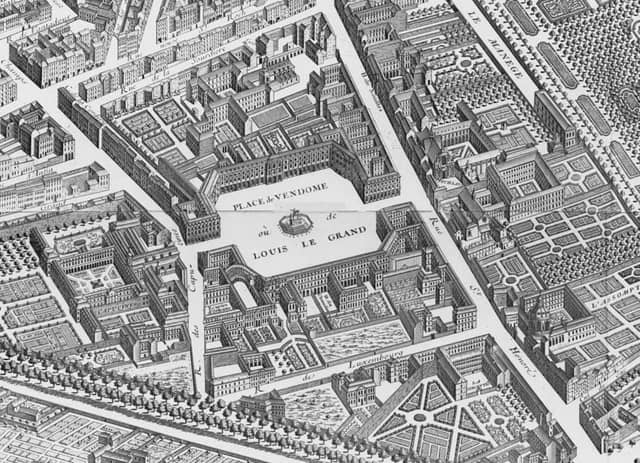
Vendôme Square in the Paris of the 17th century
The Vendôme SquareVendôme Square(place Vendôme)Vendôme Square (opens in a new tab) had a very different face before the opening of the Rivoli StreetRivoli Street(rue de Rivoli)Rivoli Street (opens in a new tab) made in only .
The square was first constructed in a square form.
This form is considered too rigid; in , part of the facades was torn down and then rebuilt, in 1701, in the present octagonal form. They are the work of the architect Jules-Hardouin MANSART (opens in a new tab).
Looking closely at the Turgot Plan (opens in a new tab), the place appears to be much calmer than actually:
on the Tuileries (opens in a new tab) side, The Castiglione StreetCastiglione Street(rue de Castiglione)Castiglione Street (opens in a new tab) (fig. 1),
on the Opéra (opens in a new tab) side, the Paix StreetPaix Street(rue de la Paix)Paix Street (opens in a new tab) in fig. 2, has not yet been pierced.
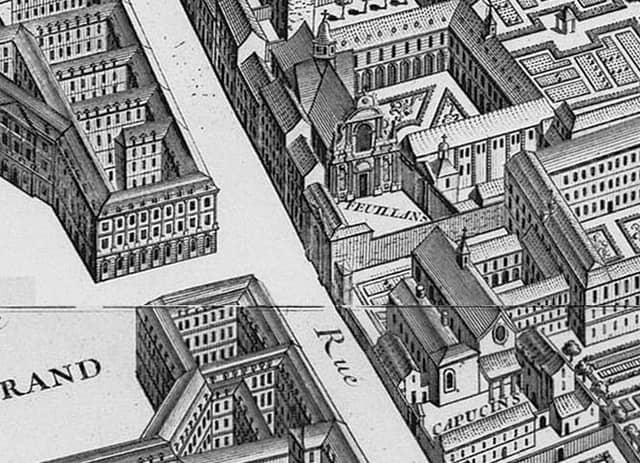
The access is only by:
the Saint-Honoré StreetSaint-Honoré Street(rue Saint-Honoré)Saint-Honoré Street (opens in a new tab) on the Tuileries (opens in a new tab) side (fig. 1 above),
and the Capucines StreetCapucines Street(rue des Capucines)Capucines Street (opens in a new tab) on the Opéra (opens in a new tab) side (fig. 2 below).
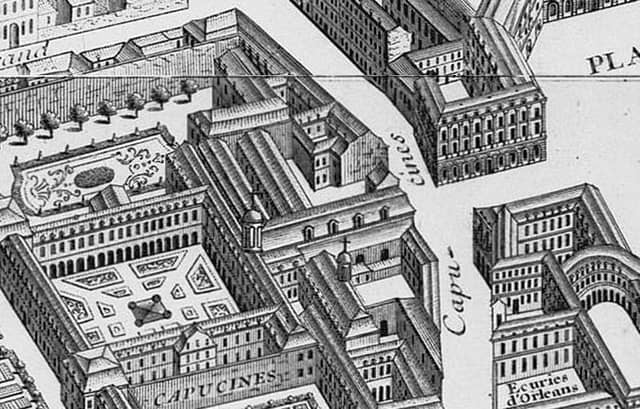
It could not be passed through as since the 19th century.
On the OperaOpera(Opéra)Opera (opens in a new tab) side, at the location of the current Paix StreetPaix Street(rue de la Paix)Paix Street (opens in a new tab), was the convent of the Capucinesconvent of the Capucines(couvent des Capucines)convent of the Capucines (opens in a new tab) (fig. 3).
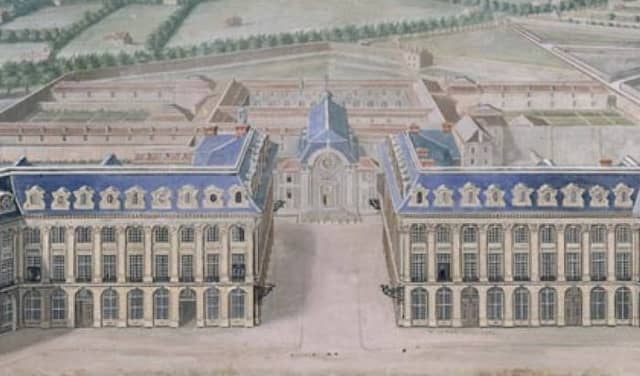
Madame de Pompadour (opens in a new tab) was buried, as was her mother and sister, in the church.
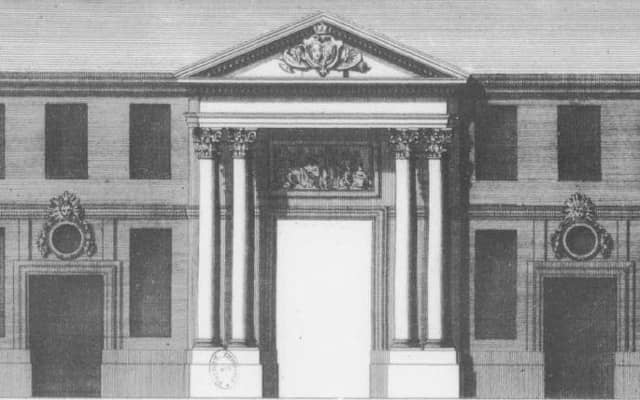
In front, on the Tuileries (opens in a new tab)' side, another portal, the portal of convent of the Capucinesconvent of the Capucines(couvent des Capucines)convent of the Capucines (opens in a new tab) was responding to it (fig. 4).
In the center of the square, was erected, since , the statue of Louis XIV (opens in a new tab) called « Louis le Grand » (fig. 5).
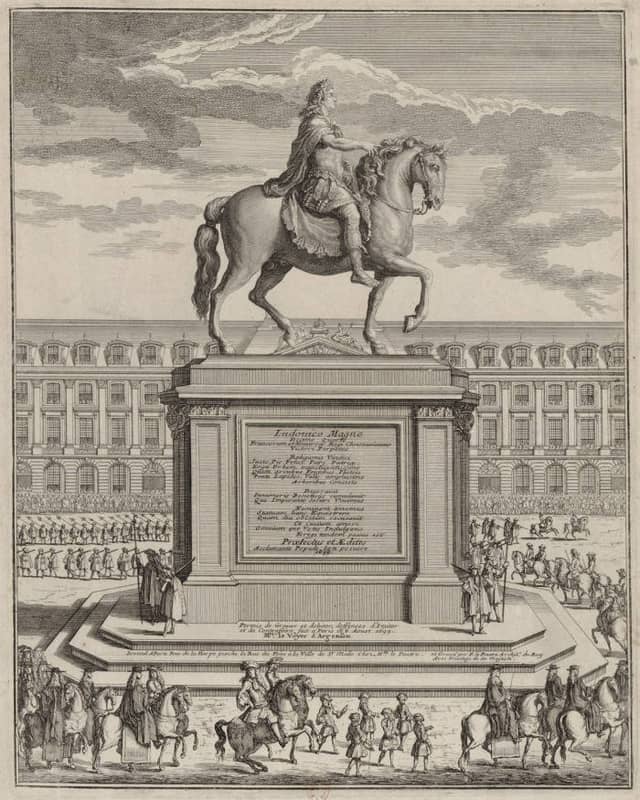
It is an impressive work by François GIRARDON (opens in a new tab) , which reaches, with its pedestal, a height of 17 m high.
The RevolutionRevolution(Révolution)Revolution (opens in a new tab) will destroy it but one of the huge feet of the king survived its melt and is exhibited at the Museum of History of the City of Paris, the Carnavalet MuseumCarnavalet Museum(Musée Carnavalet)Carnavalet Museum (opens in a new tab).